Myths, dug up
Ten things people often say about dinosaurs, and what the sources actually say. Checked on 24 Oct 2026.
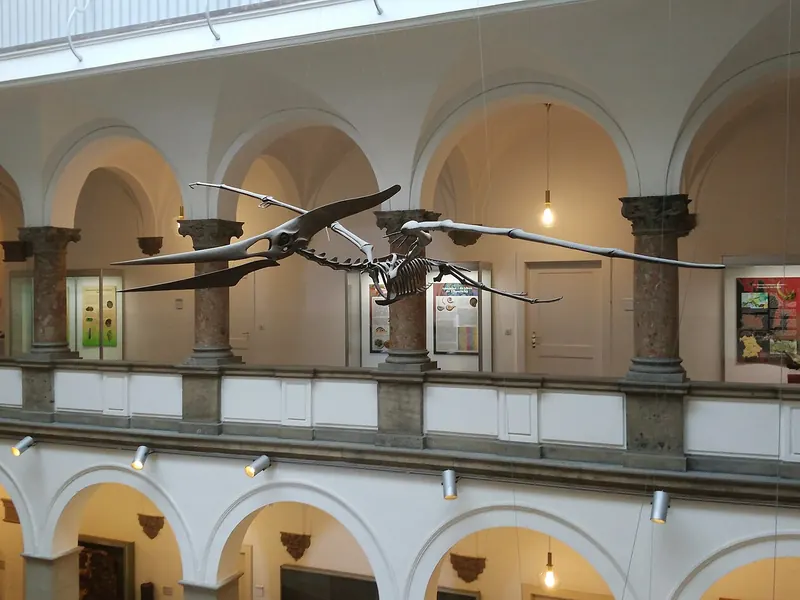
Not a dinosaur: a Pteranodon. Pteranodon was one of the largest flying reptiles. Wingspans of over 6 m are given for P. longiceps. [source · checked 24 Oct 2026]
Pterodactyls were flying dinosaurs.
Plesiosaurs were swimming dinosaurs, and Nessie is one.
Dinosaurs are all extinct.
You probably saw one this morning.
Birds are feathered dinosaurs. They evolved from theropods in the Late Jurassic, and they’re the only dinosaur lineage known to have survived the mass extinction about 66 million years ago. [source · checked 24 Oct 2026]
Brontosaurus never existed.
It’s complicated. It was dropped in 1903, brought back in 2015, and the argument isn’t over.
In 1903 Elmer Riggs decided Brontosaurus was too like Apatosaurus to be a separate genus, so for decades the name was dropped. [source] A 2015 study by Emmanuel Tschopp and colleagues found Brontosaurus to be distinct after all, though some palaeontologists still treat it as Apatosaurus. [source]
Velociraptors were as big as a person.
Iguanodon had a horn on its nose.
That was its thumb.
Early reconstructions put Iguanodon’s spike on its nose. Later fossils showed it was really a thumb spike. [source]
Stegosaurus had a second brain in its bottom.
The “second brain” idea came from a large canal Marsh spotted in the hip. Its real brain was small, though.
Stegosaurus was once said to have a “second brain” in its hips. The idea came from a large canal Marsh noticed in the hip region. [source] For such a big animal, Stegosaurus had a small braincase, no larger than a dog’s. [source]
T. rex was just a scavenger.
Most palaeontologists say predator.
Most palaeontologists today accept that T. rex was a predator. The idea that it was mainly a scavenger has been discredited. [source]
Dinosaurs were all enormous.
Dinosaurs were slow, tail-dragging lumps.
Even in 1897 one painter showed them leaping.
Charles R. Knight’s 1897 painting Leaping Laelaps was one of the few pictures before the 1960s to show dinosaurs as active, fast-moving animals. [source] All dinosaurs stood with their legs straight underneath them, like birds, rather than sprawled out to the side like a lizard’s. [source]